
Built for every modification the internet can throw at your art.
The artworks above are from the game Glitch, whose studio released its art into the public domain (CC0). They are part of the corpus Candela trains on. Registered work is never used for training unless its artist opts in.
Candela is an image recognition model built for a single question: are these two images the same work? Crops, filters, screenshots and recompression do not change the answer, and holding up against AI edits is a design goal we are actively measuring against. Candela powers every verification on Lantern, and it is built to stand on its own.
Proof you can look at.
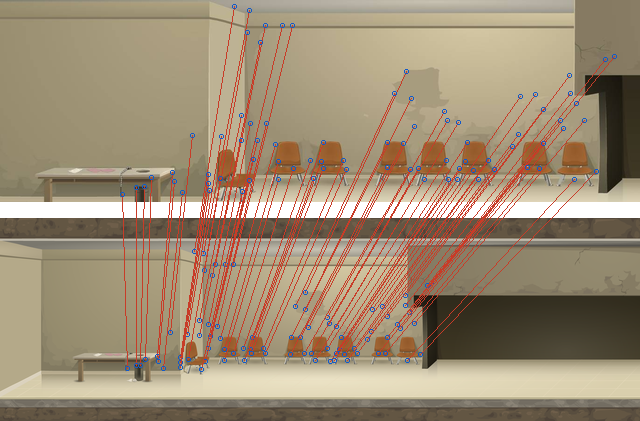
A cropped and recompressed copy, matched back to its original. The artwork is a public-domain piece of digital game art. Each line is a point the in-development verification stage confirmed in both images.
Built for art by design.
Candela is specialized for digital art. The version serving traffic today, candela-2.2, is a single art-specialized model fine-tuned on openly licensed art; it replaced the three-model ensemble that served before it. Every match carries a similarity score whose thresholds are tuned against measured outcomes, and a point-by-point geometric verification stage is in development.
of altered copies caught by the art-specialized model serving traffic today, at a 1% false-alarm budget